
When CALM Is the Signal: What Marriage and Home Decisions Taught Me About Reflection
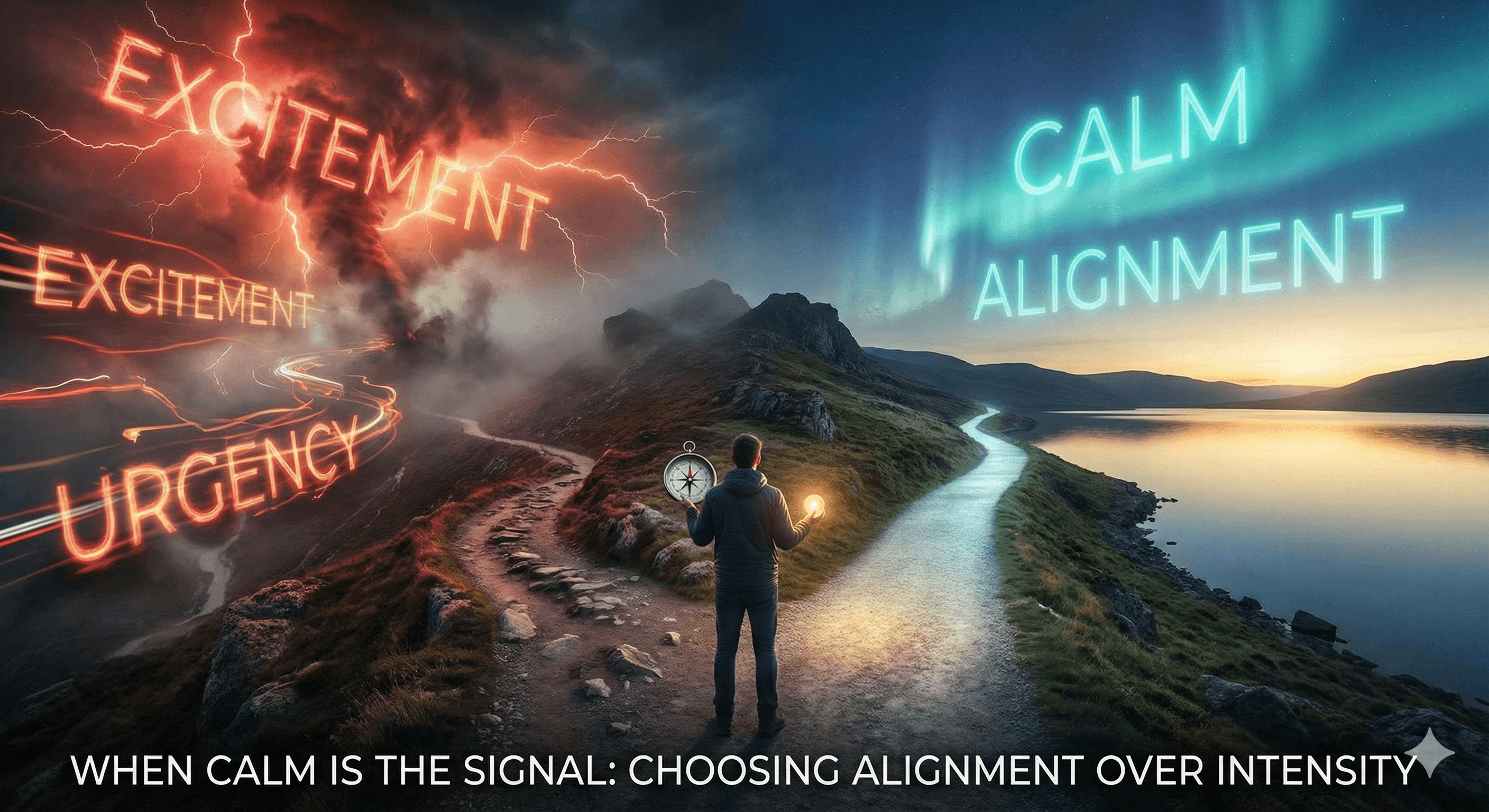
AI generated Image
We are often told that big decisions should come with excitement — racing hearts, butterflies, urgency, drama.
If we don’t feel that surge, we quietly wonder:
- Am I missing something?
- Am I settling?
- Is this fear pretending to be calm?.
With time, experience, and reflection, I’ve learned something different.
Calm is not the absence of feeling.
Calm is the presence of alignment.
The First Time I Trusted Calm
Thirteen years ago, I married my wife six weeks after meeting her.
On paper, it made no sense. I had been married twice before. No previous relationship had lasted more than three years. By all conventional wisdom, this decision should have come with anxiety, hesitation, or at least emotional fireworks.
Instead, it came with calm.
Not numbness. Not denial. Just a deep, settled sense that I was fully present, fully honest, and not hiding any part of myself.
Difficulties came later — as they always do in real relationships — but they did not undo the decision. We walked through them together. Thirteen years on, that same calm remains, alongside trust, growth, and genuine excitement about the future.
That experience taught me something quietly profound:
Excitement predicts intensity.
Calm predicts sustainability.
The Same Signal, Years Later
Today, my wife and I are making decisions about home in the UK and in Nigeria.
In Aberdeen, we’re considering a three-bedroom flat that meets our needs practically and flexibly. It works if our children join us. It works if they don’t. It works as a future rental. It works with our work locations and our health. It doesn’t shout from the outside, but it supports life on the inside.
In Nigeria, instead of rushing to build something symbolic elsewhere, we’re choosing to upgrade an existing family home — making it peaceful, functional, and ready whenever we are there. Solar. Comfort. Simplicity. A place that works now, without forcing the future to arrive early.
Once again, I notice the same feeling:
- No butterflies.
- No noise.
- Just calm.
What CALM Actually Feels Like
Through reflection, I’ve learned that calm has a distinct texture:
- Settled, not flat — there is clarity without emotional force.
- Grounded, not fearful — risks are acknowledged without panic.
- Spacious, not urgent — options remain open.
- Quietly confident, not performative — decisions don’t need defending.
Calm often gets mislabelled as hesitation or lack of ambition. In reality, it’s a sign that a decision is integrated across values, relationships, timing, and capacity.
Why Reflection Changes Decision-Making
Since turning 50, my guiding philosophy has been simple:
Increase simplicity. Reduce complexity.
Reflection has helped me recognise when I’m choosing from alignment rather than from pressure — pressure to impress, to prove, or to rush.
Instead of asking “Does this excite me?”, I now ask different questions:
- Does this decision make my life lighter or heavier?
- Will I need to keep explaining or justifying it?
- Does this choice leave room for change without regret?
- Can I imagine living with it on an ordinary Tuesday?
These questions don’t create excitement. They create clarity.
CALM Is Not Settling — It’s Maturity
The biggest shift for me has been realising this:
Calm is not what you feel when you give up.
Calm is what you feel when you stop betraying yourself.
It’s the signal that your nervous system, your values, and your lived experience are finally speaking the same language.
And that signal can be learned.
Why This Matters at MaxME Solutions
At MaxME Solutions, we help individuals and organisations develop Reflective Intelligence — the ability to pause, sense, interpret, and choose wisely under pressure.
CALM is not accidental. It is a trainable meta-skill. When people learn how to reflect properly, they:
- Make better career decisions.
- Reduce burnout and decision fatigue.
- Stop confusing urgency with importance.
- Choose paths that endure, not just impress.
Sometimes the most powerful decisions don’t shout. They settle.
And when you learn to trust that signal, life becomes lighter to carry.
If you recognised yourself in this — the quiet questioning, the search for reassurance, the sense that calm might actually be wisdom — then reflection is already working in you.
The next step is learning how to use it deliberately.
Tags:
Comments (0)
Get started
Want to explore this further?
Book a discovery call to discuss how reflective capability development can support your organisation.